
Our Curlew Story
My first encounter with a curlew family on the farm was quite alarming.
It was our first summer here, and looking back, I have no idea how I’d missed a whole spring of their amazing calls overhead. However, I had. I walked into an old outbuilding and came face-to-face with four chirping chicks. Having got over the initial surprise, I moved into the “cuteness appreciation” phase—until an adult curlew, with a 15 cm long beak, dive-bombed me from a beam above. I fled.
Now, 14 years later, both John and I wait to hear the first calls of the returning adults in early March. Throughout April, we watch them pairing up and choosing a nesting site. We get the binoculars out, and for the next few evenings John finds a suitably sheltered spot to observe their activities. Once we’re confident they’ve settled, it’s time to report to the Cumbria Curlew Society, and one of their very accomplished spotters arrives to help locate the nest.
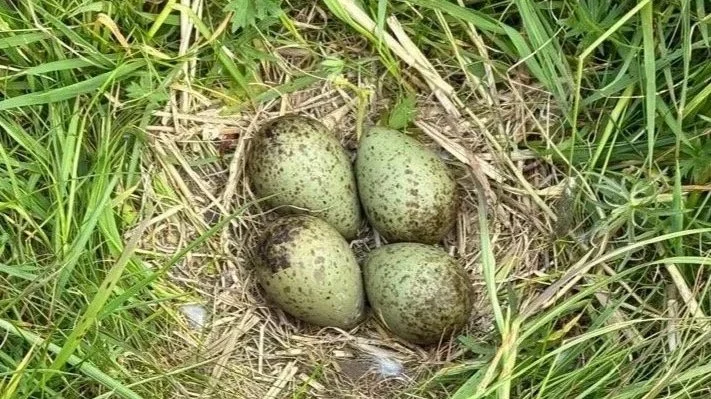
I imagine, more by good luck than good management, the curlews have chosen a field with no public footpath for the past three years, reducing the chances of disturbance from dogs. It can also be gated off from our cows, who are always looking for fresh grass. The female lays one egg a day until there are four. Only then do the birds take turns sitting on the nest.
That is the cue for the volunteers from the Cumbria Curlew Society to arrive en masse in our yard on a Saturday morning, armed with electric fencing, solar panels, stakes, a mobile camera, and a strimmer.
With great efficiency, and keeping disturbance to an absolute minimum, they set to work. A square around the nest is carefully strimmed, the electric fence erected to deter foxes and badgers, and the camera put in place. Within twenty minutes, they are done and back in our yard. Then comes a long 28 days of daily camera checks and listening for their unmistakable calls, reassuring us they are still with us. If the calls stop, we know the nest has likely been lost.
After four weeks, John begins visiting the nest daily, looking for signs of hatching. The unborn chicks have a sharp point on the end of their beaks which enables them to break the shell from within. It drops off after a day or two. At the first tell-tale crack in an eggshell, the same team from the Curlew Society are back within the day to catch, ring, and assess the chicks.
The adult birds’ real work now begins: constantly calling and alerting the youngsters to danger as they grow. Unlike their tree-nesting cousins, curlew chicks live out in the open and face far greater risks. Their feet are large and very well developed at birth, giving them a huge advantage when running from danger. This continues for the next five to six weeks until, with a lot of luck, the chicks fledge and eventually return to the coast.
We shan’t see them again until they are fully mature adults in two or three years’ time, when they will return to form nesting territories relatively close to where they were born.
In 2025, the South Lakes Curlew Society protected 29 nest sites, from which 78 chicks hatched and 27 fledged. Sadly, our nest did not make it that year after a fox found it, but this year (2026) we have two protected nest sites and are praying for a more positive outcome. It would be wonderful to successfully guide two families safely away.
We are incredibly grateful to the Curlew Society and all their volunteers for their help and support in protecting these beautiful birds.